
Up to €32,000 to Upgrade Your Home: Cyprus Energy Grant Opens 20 October
The Ministry of Energy has set the date for the Cyprus Energy Grant. From 9am on Tuesday 20 October 2026, homeowners in Cyprus can apply for a share of a €20 million fund that pays up to €32,000 towards making an older home cheaper to heat, cool and run.
According to the ministry, applications are assessed first come, first served, and the window closes on 30 December, or sooner if the budget runs out. Below is our summary of what has been published so far, and where to find the official detail.
This post is our reading of the Ministry of Energy’s published documents as of 12 October 2026. It is a guide, not the rulebook. The scheme’s terms can change, and the official sources listed further down are the authority. Bio Energy can explain what the scheme says and where our products fit, but we do not assess homes or handle applications.
The short version
What | Detail |
|---|---|
Scheme | Save – Upgrade Homes 2026 (Εξοικονομώ – Αναβαθμίζω στις Κατοικίες), third call |
Total budget | €20 million, co-financed by the EU Regional Development Fund and the Republic of Cyprus |
Opens | 9am, Tuesday 20 October 2026 |
Closes | 11.59pm, 30 December 2026, or earlier if the budget is used up |
Maximum grant | €32,000 or €24,000 per home, depending on the type of upgrade |
How applications are ranked | First come, first served, in order of submission |
Where to apply | Online only, at fundingapps.meci.gov.cy |
Helpline | 17107 |
Who the ministry says can apply for a Cyprus Energy Grant
The scheme is for private individuals upgrading an existing home. As published, the main conditions are:
- The applicant lives permanently in Cyprus.
- The home is owned by a person, not a company, and is not used for business activity. If the applicant is not the owner, the owner’s consent is needed.
- It has an EAC electricity account on a domestic tariff, in an individual’s name.
- It is old enough. The home was first connected to the grid before 1 January 2008, or the planning or building permit application was submitted before 21 December 2007.
The ministry’s FAQ says it does not matter whether the property is a main residence or a holiday home. Each person can submit one application in this round.
What the Cyprus Energy Grant Covers
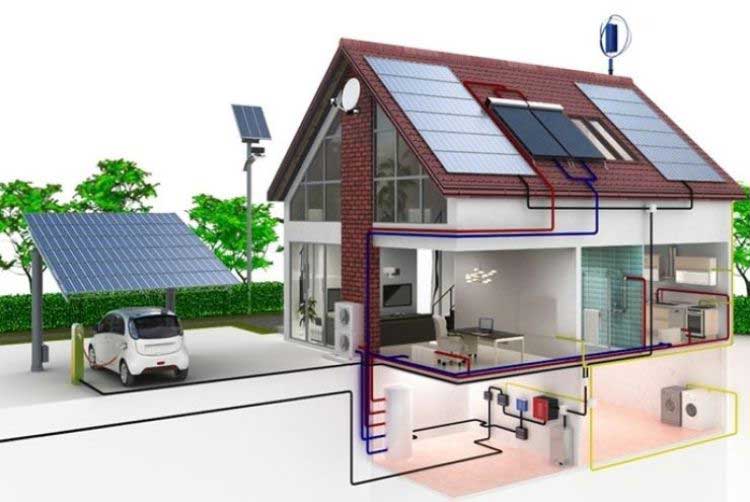
The ministry's published list covers the building itself and the systems inside it:
Solar- Thermal insulation of roofs, walls and exposed floors
- Replacement windows and doors
- External shading systems
Solar water heaters - High-efficiency split air conditioning units
- High-efficiency heat pumps for central heating and cooling
- Photovoltaic systems on net billing, up to 10kW
- Battery storage for the photovoltaic system, up to 4kWh
- The fees of the Qualified Expert who issues the energy certificates
According to the ministry, the grant is a fixed amount for each measure, not a percentage of your invoices, so what you actually pay a supplier does not change it. The amounts are set out in the scheme’s Implementation Guide. Equipment also has to meet the scheme’s minimum technical standards. For split air conditioners, for example, the published requirement is an energy label of at least A++ for cooling and A+ for heating.
A whole-home upgrade, not a single purchase for the Cyprus Energy Grant.
This is the part the headlines tend to skip. As the scheme is written, the grant is not a discount on one item. The ministry’s documents set two conditions on the upgrade as a whole:
- A saving of at least 60% in the home’s primary energy use.
- At least one measure on the building’s shell: insulation of the roof or exposed floors, insulation of the walls, or replacement windows and doors.
In other words, solar panels and air conditioning on their own would not qualify, however good they are.
The ministry has announced two levels of grant:
- Type A, up to €32,000. The home reaches Nearly Zero Energy Building standard and saves at least 60%.
- Type B, up to €24,000. The home saves at least 60%, without reaching the Nearly Zero standard.
It has also said that vulnerable consumers, homes in mountain areas and homes in refugee housing estates qualify for higher amounts. The Implementation Guide lists a higher amount for each measure for these groups, and defines mountain areas by postcode. Which combination of measures gets a particular house to 60% is a question for a Qualified Expert, not for us.
The Energy Performance Certificate comes first
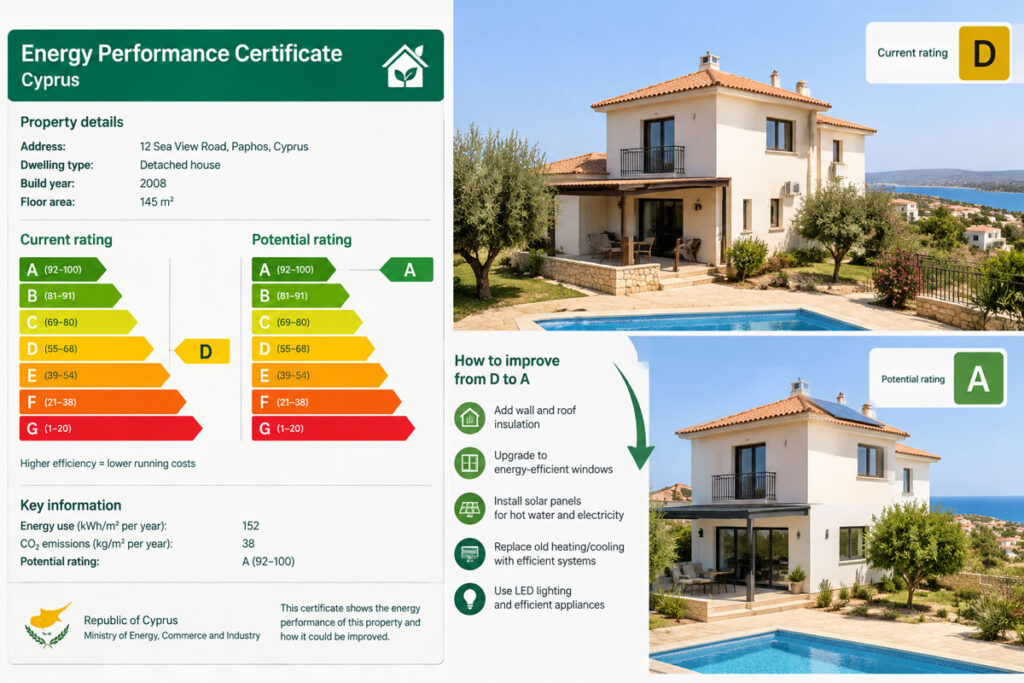
The 60% saving is measured by comparing two Energy Performance Certificates (EPCs): one showing the home as it is now, and one issued after the work. According to the ministry’s documents:
- The first EPC should be issued after 15 May 2026. The FAQ allows an earlier certificate if the expert declares that they have visited since that date and that it still reflects the home.
- Only work carried out after the first EPC is eligible.
- The EPC comes from a Qualified Expert on the Energy Service’s register, and it is needed before you apply.
The expert’s fee is agreed privately between you and them. The ministry’s FAQ notes that no grant is paid towards it if an application is not submitted or is rejected. The official register is here: Register of Qualified Experts. We are not in a position to recommend any individual expert.
How the ministry describes the process
The ministry’s FAQ sets out the steps roughly as follows. Treat this as a summary, and check the official version before you act on it.
- Contact a Qualified Expert, who visits the home, issues the first EPC and recommends the measures needed to meet the scheme’s conditions.
- Confirm that the home’s first grid connection was before 1 January 2008. The FAQ refers to a certificate from the EAC.
- Gather the supporting documents listed on the ministry’s website.
- Register and verify your identity on the government portal. The FAQ calls it Ariadni; the login service is now CY Login. A verified account you already hold can be used.
- Log in to the ministry’s application system at fundingapps.meci.gov.cy, complete your profile and submit the application. The ministry says to use Chrome, Firefox or Edge.
A few points from the FAQ are worth knowing before you start:
- Quotes are not submitted with the application. You declare the measures you plan from a set list.
- The measures are fixed once you submit. The FAQ says they cannot be added to or swapped afterwards.
- Approved applicants have 12 months to complete the work and obtain the final EPC, counted from the approval letter. The guide allows an extension of up to six months on request.
- You can wait for approval before spending. Work started earlier is at your own risk.
How and when the Cyprus Energy Grant is paid
It is the first thing most homeowners ask, and the short answer is: after the work, not before. According to the ministry’s Implementation Guide (version dated 30 September 2026):
- You fund the work first. The guide describes one payment, made once the upgrade is finished and checked. It makes no mention of advance payments.
- Approval comes with a signed agreement. Approved applicants sign a Public Funding Agreement, in which the state commits to pay the grant provided the scheme’s terms are met.
- You claim the grant when the work is done. The expert revisits and issues the final EPC. You then submit a payment request through the same online system, with the final EPC, the expert’s report and the documents listed for each measure. The guide says to do this within one month of your completion deadline.
- The ministry checks before it pays. Every claim gets a paperwork check, and a site visit is possible.
- The money comes from the ministry’s accounts department, which the guide describes as paying by remittance.
- The amount is fixed per measure, so it does not rise or fall with your invoices. The guide still tells applicants to keep invoices and receipts, because the ministry can ask for them.
What the guide does not say is how long payment takes once a claim is submitted. The minister acknowledged delays in the previous round and said in May that the checking process had been made faster. If the timing matters to your budget, that is a question for the helpline on 17107.
Two further points from the guide are worth knowing. The state can set off anything an applicant owes it against the payment, and applicants are expected to have their social insurance, VAT and income tax affairs in order. And the upgrade has to stay in place, with the home kept in residential use, for five years after payment.
If you are thinking of applying
Applications open at 9am on 20 October and the ministry says they are ranked in order of submission, so earlier is safer. The window is due to stay open until 30 December unless the budget runs out first, and this is not a decision to rush without the facts.
Things you could consider doing now:
- Speaking to a Qualified Expert, since everything else follows from the first EPC.
- Checking that you have a working, verified CY Login account.
- Asking the EAC to confirm your home’s first connection date.
- Deciding which measures you want, and talking to the suppliers involved, before the application fixes them.
Official sources
For anything about the Cyprus Energy Grant itself, these are the places to go:
- Helpline: 17107
- Implementation Guide: the ministry’s guide to the 2026 call (PDF, in Greek)
- Scheme page: the ministry’s Industry and Technology Service, meci.gov.cy/sit
- Frequently asked questions: the ministry’s FAQ (PDF, in Greek)
- Register of Qualified Experts: epc.meci.gov.cy/QE.html
- Application system: fundingapps.meci.gov.cy
Where Bio Energy fits
We supply and install solar photovoltaic systems and air conditioning, two of the measures on the ministry’s list. We are happy to talk you through what the scheme says and which parts of it we can help with. We are not a one-stop shop for it: we do not carry out EPCs, insulation or window replacement, and we do not submit applications. For those, and for a ruling on any detail, please use the official sources above.
What we can do is quote for the solar and cooling part of your plan and give you the specifications of the equipment, so your expert can check it against the scheme’s technical requirements. Because the measures are fixed once an application goes in, it is worth having that conversation before you apply.
According to the ministry’s Implementation Guide dated 30 September 2026, the fixed grant amounts for the measures we supply are:
Measure | Standard grant | Increased grant |
|---|---|---|
Photovoltaics, up to 10kW | €450 per kW | €1,000 per kW |
Batteries, up to 4kWh | €720 per kWh | €960 per kWh |
Split air con, up to 4kW | €290 per unit | €390 per unit |
Split air con, over 4kW | €525 per unit | €700 per unit |
The increased grant applies to vulnerable consumers, homes in mountain areas and homes in refugee housing estates, as the guide defines them. At the standard rate, the most the grant pays is €4,500 towards a 10kW photovoltaic system and €2,880 towards a 4kWh battery. The amounts for insulation, windows and the other measures are in Annex A of the guide.
One thing we would rather say up front. In our experience, solar on net billing is less favourable than the old net metering, and in some cases the EAC does not permit export to the grid at all, which makes battery storage essential. The scheme’s list refers to batteries of up to 4kWh, and many homes need a good deal more than that. We will size and price the system you actually need, not just the part the grant recognises.
If a full upgrade is more than your home needs, there are still simpler ways to cut the bill. Solar air conditioning runs on panels wired straight into the unit, with no batteries and no grid application. And while pellet stoves and wood burners are not on the grant’s list, they are still a simple, proven way to heat a Cyprus home in winter.
Call us on 96 578 001 or book an appointment. Bring your expert’s recommendations if you have them, and we will tell you honestly what makes sense for your place.
Get in touch now by calling +357 96 578 001 or email info@ambioenergy.com
Read our Blog | Read more about Solar | Contact Us | Follow us on Facebook